

Last Updated: November 5, 2026
Quick Summary
Authentic architectural hardware is door, window and gate ironmongery from the original manufacturer, matching the specification it was certified against, with traceable documentation. Verify it by confirming the supplier's authorised channel status in writing, reconciling batch and serial numbers, and obtaining the declaration of performance or test certificate for fire-rated and panic items.
- Genuine stock travels a documented route: manufacturer, authorised distributor, project site.
- Hardware on a fire-rated door must be tested as part of that door system, not as a separate component.
- Finish codes are where substitutions hide, so compare them line by line against the approved door schedule.
- Retain one unopened unit per batch as your reference sample if a dispute arises mid-project.
- A closer rated for a 60 kg leaf is the wrong closer on an 80 kg fire door.
Table of Contents
- What Authentic Architectural Hardware Means in Practice
- A Practical Checklist for Verifying Authentic Hardware
- Getting Architectural Hardware Specifications Right for the Project
- Hardware Product Certification and Warranty: What to Ask For
- Comparing Authentic Hardware Options and Costs
- Ordering Verified Hardware for Your Next Project
- Frequently Asked Questions
What Authentic Architectural Hardware Means in Practice
Authentic architectural hardware is door, window and gate ironmongery from the original manufacturer, matching the specification it was certified against, with traceable documentation. At Al Kaukaban Enterprises LLC, the same question comes up in almost every bulk order: is this genuinely what the specifier approved?
The stakes are higher than they look. 6Wresearch's forecast for the architectural hardware market points to continued growth through 2032, meaning more product entering the supply chain and more opportunity for unauthorised stock to slip in.
The Difference Between Genuine and Grey-Market Stock
Genuine stock travels a documented route: manufacturer, authorised distributor, project site. Grey-market stock is real product sold outside that route; counterfeit stock is a copy. Both create the same problem on site.
Doorhub's guidance on Civil Defense compliance for interior doors makes the point clearly: hardware on a fire-rated door must be tested as part of that door system, not treated as a separate component. A closer bought outside the approved channel may not carry the test evidence your handover file needs.
The practical difference shows up in three places: certification paperwork, warranty support, and whether the finish matches the batch you specified.
A Practical Checklist for Verifying Authentic Hardware
Verification is a document exercise before it is a visual one.
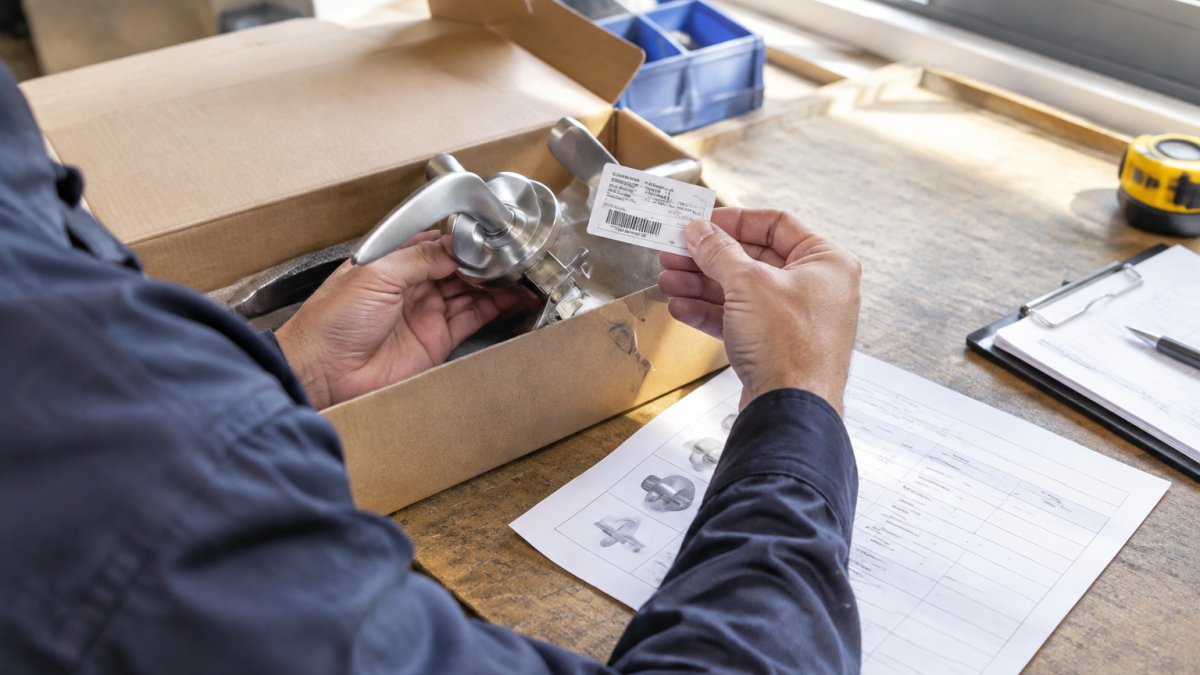
1. Confirm the supplier's channel status in writing. Ask for a current authorised-distributor or authorised-dealer letter from the manufacturer, naming the exact product families you are buying.
2. Match the specification line by line. Compare the manufacturer's name, model number, finish code and handing (left or right) against the approved door schedule.
3. Obtain the Declaration of Performance or test certificate. For fire-rated or panic hardware, this is essential. The certificate must match the specific product and its intended application.
4. Reconcile batch and serial numbers. The batch or serial number on the box must match the delivery note and the manufacturer's traceability record.
5. Verify the product meets the specified standard. Check that the product is tested to relevant UAE standards or internationally recognised standards accepted in the UAE, such as BS EN standards.
6. Compare finish against the approved sample in daylight. Batch-to-batch variation in plated and powder-coated finishes is normal within a manufacturer's tolerance and abnormal across suppliers.
7. Confirm who honours the warranty locally. A manufacturer warranty pursued overseas is of limited value on a project with a defects liability period.
8. Retain an unopened unit per batch. This serves as your reference sample if a dispute arises mid-project.
Watch out: accepting a consignment because the boxes, logos and colours look right is the most common mistake on site.
Where a supplier cannot produce items 1, 4 and 5, escalate before installation rather than after. Once hardware is fitted, removing it to resolve a documentation gap costs far more than the hardware itself, and a fire door fitted with unverified ironmongery may need the whole leaf re-certified.
Getting Architectural Hardware Specifications Right for the Project
Good architectural hardware specifications start with the door, not the catalogue.
Door Handle SN Gamet DH-98A-24Z-07-KW--BL Made in Poland →
Step 1, Fix the door schedule first. Record leaf width, leaf weight, thickness, core material, fire rating, acoustic rating and intended use for every door. Hardware is selected against those numbers, not against a showroom display.
Step 2, Grade the environment. Coastal and humid conditions punish plated finishes and lower-grade stainless steel. For external and coastal-facing doors, specify the stainless grade in writing and confirm fixings and springs match the grade of the visible hardware.
Step 3, Coordinate fire-rated doors as a system. On a fire-rated leaf, the closer, hinges, locks, exit devices and intumescent seals must be compatible with the tested door assembly.
Step 4, Settle accessibility requirements. Door opening force, handle type and operating height are the three items that most often fail an accessibility review. Lever handles are generally preferred over knobs on accessible routes, and closer force settings need to be adjustable so the installed door can be tuned to the required opening force after commissioning rather than replaced.
Step 5, Match hinges and handles to traffic. A busy entrance needs heavier gauge hinges and a handle with a firm, comfortable grip rather than a slim decorative lever. For heavy doors, a heavy-duty concealed hinge rated for the leaf weight gives a cleaner look without sacrificing strength.
Step 6, Decide where a heavy duty closer earns its cost. A heavy duty door closer is worth specifying wherever a door is wide, heavy, or heavily used: main entrances, plant rooms, stairwell doors, and anything on a fire escape route. You can see a heavy-duty closer with back check in our range to compare against your door weight and width.

Step 7, Write the specification as a single controlled document. One document containing the door schedule, finish codes, certification requirements, stainless grade and accessibility criteria is what the supplier quotes against and the site team inspects against.
Hardware Product Certification and Warranty: What to Ask For
Certification and warranty questions should be settled before the purchase order, not after delivery. Ask for four things: the standard the product is tested to, the certificate reference, the warranty period in writing, and who honours that warranty locally.
Suppliers in this market commonly reference BS EN standards, and fire-rated and certified products are a normal part of a serious hardware range, as Aqfal's product listings illustrate. If a supplier cannot name the standard, treat the claim as unverified.
Branded products make this easier. A Yale hydraulic door closer rated to 80kg comes with published specifications you can check against the door schedule, and a warranty you can actually pursue.

Comparing Authentic Hardware Options and Costs
Cost comparisons only mean something when you compare like with like. A handle at AED 15.00 and a handle at AED 55.00 differ in material and finish.
| Option | Price (AED) | Best for | Consideration |
|---|---|---|---|
| Zinc door handle, rosette set | 15.00 | Residential interiors, volume orders | Light fittings; check finish warranty |
| Sultan door handle | 55.00 | Commercial doors, heavier use | Higher upfront cost, longer service life |
| AISI 304 handle and rosette set | Quote on request | Coastal, humid, marine-adjacent sites | Specify grade in writing |
| Abloy electric lock EL560 | 2,400.00 | Controlled commercial access | Needs access control or timer wiring |
| Altix R9 Pro smart lock | 325.91 | Villas, offices, short-term rentals | Fingerprint, PIN, card and app access |
For a like-for-like view of handle options, the AISI 304 handle and rosette set gives you a stainless grade you can put straight into a coastal specification.

Ordering Verified Hardware for Your Next Project
Order from a supplier who will put the specification in writing. Send your door schedule, finish codes and certification requirements as one document, and ask for written confirmation that the quoted items match it line by line.
A genuine replacement part is easy to recognise once you know the markings. The Fuhr replacement UPVC gear box centre case shows what an authentic, correctly specified component looks like before you commit to a bulk order.
Frequently Asked Questions
How can you tell if architectural hardware is authentic?
Start with the paperwork, not the product. Ask the supplier for the manufacturer's certificate of conformity, the test standard the item was certified to, and a traceable batch or serial number. Check that the finish, weight and machining match the specification sheet, and that the packaging carries the maker's branding rather than a plain label. Buy from a supplier who will put the brand, standard and warranty in writing on the quotation, so any mismatch is documented before delivery.
What documents should a supplier provide for architectural hardware specifications?
Request the technical data sheet, the certificate of conformity to the relevant standard, fire-rated test evidence where the door is a fire door, and the manufacturer's warranty terms. For access control items, ask for the wiring and compatibility details so the lock works with the existing system. A supplier should be able to match every line on your schedule to a named product and a certificate.
Is a heavy duty door closer worth it for high-traffic doors?
Yes, where the door sees constant use. A standard closer on an entrance with heavy footfall loses adjustment quickly, and the door then fails to latch, which is a security and fire-safety problem. A heavy duty door closer holds its closing force over far more cycles and keeps the door under control. Match the closer's power size to the door leaf width and weight, and confirm it is compatible with the fire-rated door system if the door is certified.
Why does hardware compatibility matter when selecting door components?
A fire-rated door is certified as a complete system, so the hinges, closer, lock and handles must be tested with that door, not added afterwards. Hardware must be compatible with the fire-rated door assembly rather than treated as a separate item. The same logic applies to access control: an electric lock must suit the door material, handing and existing control system. Confirm compatibility in writing before ordering, because a mismatched component can void the certification.
Most procurement problems in this category trace back to a specification that was never written down. Al Kaukaban Enterprises LLC has supplied architectural hardware, container fittings and locking solutions since 1977, with SS304-grade options for demanding and coastal conditions and a physical shop behind the online catalogue. Send us your door schedule and we will confirm what matches it. Get started with Al Kaukaban Enterprises LLC and specify hardware you can verify.


