

Last Updated: November 1, 2026
Quick Summary
You can find compliant marine hardware from suppliers who show material grade, a standard reference such as an IMPA number, and fileable documentation before you pay. Buy against IMPA numbers and request a full documentation pack, including an EN 10204 type 3.1 material certificate tied to the delivered batch.
- Buy against an IMPA number so the order leaves less room for substitution.
- 316 stainless steel suits deck hardware, rails and cleats exposed to spray.
- Request a documentation pack rather than individual documents from suppliers.
- Check the issuer, scope and batch traceability link on every certificate.
- Score suppliers red, amber or green and require green on provenance and compliance evidence.
Table of Contents
- What Compliant Marine Hardware Actually Means
- IMPA-Marked Fittings: A Practical Shortcut to Compliance
- 316 Stainless Steel Marine Fittings vs Bronze and Brass
- Marine Hardware Certification and Documentation to Request
- How to Vet Marine Hardware Suppliers Beyond Price
- Marine Hardware Maintenance Checklist for Saltwater Service
- Matching Hardware to Your Vessel and Duty
- Ordering Compliant Marine Hardware for Your Next Job
- Frequently Asked Questions
What Compliant Marine Hardware Actually Means
Compliant marine hardware is equipment manufactured and documented to meet recognised marine standards for material grade, load capacity and traceability, so it performs safely in saltwater service and passes survey.
It is not. Grade, marking and paperwork decide compliance, and finding compliant marine hardware means finding a supplier who can show you all three before you pay.
Three things define compliance in practice:
- Material grade stated and matched to the duty, typically 316 stainless steel or a specified bronze alloy for saltwater exposure
- A standard reference on the part, such as an IMPA number, so the item can be cross-checked against a specification
- Documentation you can file, including material certificates and test references, so a surveyor or procurement auditor can verify the purchase
Miss any one of those and you have hardware, not compliant hardware.
IMPA-Marked Fittings: A Practical Shortcut to Compliance
A practical way to specify marine hardware is to buy against an IMPA number. IMPA, the International Marine Purchasing Association, maintains a standard catalogue of part numbers used across the marine supply chain.
A purchase order reading "IMPA 330875 Storz type bronze hose coupling" leaves far less room for substitution than "bronze hose coupling." IMPA-marked lines are available for exactly this reason, including the IMPA 493401 watertight door handle and the IMPA 232481 stainless steel scupper plug for ship deck use.
Watch out: an IMPA number printed on a box proves nothing on its own. Ask for the number on the part or its packaging and match it to the catalogue entry before signing off.
316 Stainless Steel Marine Fittings vs Bronze and Brass
Neither material wins outright; the choice depends on where the fitting sits and what it touches. 316 stainless steel marine fittings, with molybdenum added to resist chloride attack, suit deck hardware, hand rails, cleats and awning fittings exposed to spray. Bronze and brass suit valves, hose couplings and fittings where machinability and a long history of seawater service matter more than tensile strength.
| Material | Best For | Saltwater Behaviour | Watch Point |
|---|---|---|---|
| 316 stainless steel | Deck hardware, rails, cleats, locks | Strong chloride resistance | Avoid stagnant wet crevices |
| Bronze | Valves, hose couplings, pump fittings | Long-established marine service | Verify alloy grade, not just "bronze" |
| Brass | Padlocks, light-duty fittings | Moderate resistance | Not for continuous immersion |
Marine Hardware Certification and Documentation to Request
Most supplier pages tell you to "ask for certificates." Few tell you which certificates, issued by whom, covering what, and how to check that the paper applies to the part in the box.
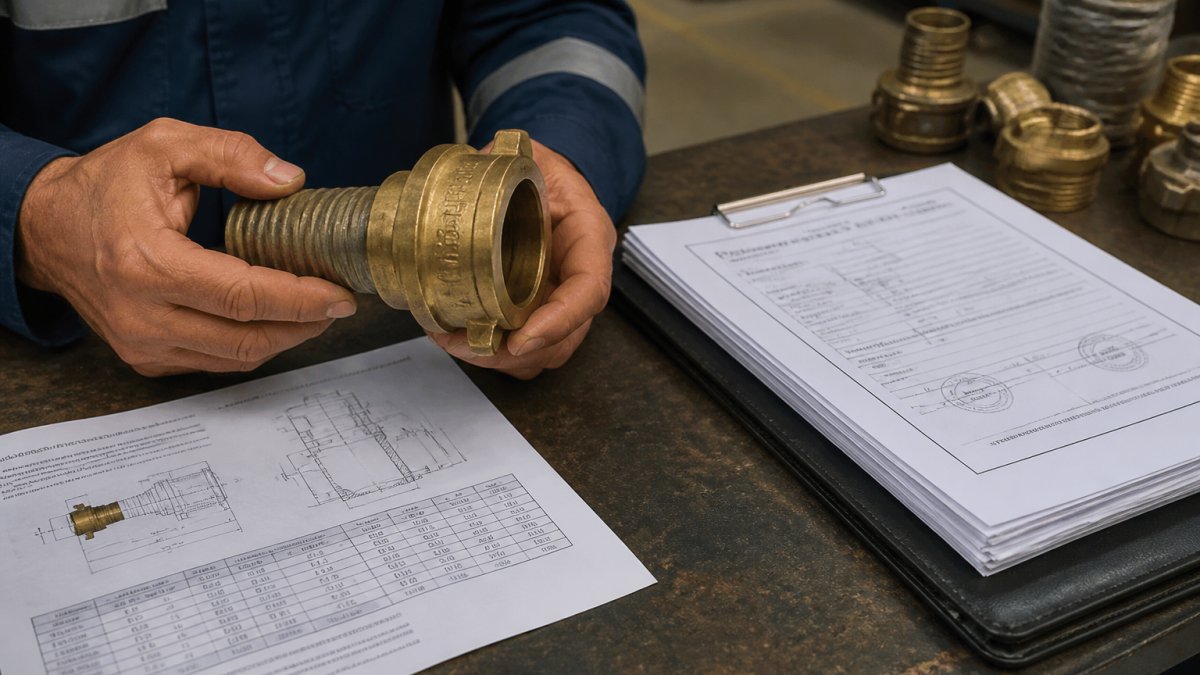
Start by establishing the requirement chain before you request anything. Four inputs generally decide which documentation is relevant:
- Vessel type and flag state. A recreational craft, a commercial vessel, and an offshore unit are surveyed against different regimes. The flag administration and the recognised organisation acting on its behalf set the survey expectations.
- Classification society rules, where the vessel is classed. If the vessel is classed, the society's rules for the hardware category govern material, testing, and marking, and the society's surveyor, not the supplier, is the final word on acceptance.
- Hardware function and criticality. A deck cleat, a watertight door lock, and a fire-rated bulkhead door handle carry different duty and therefore different evidence requirements. Load-bearing and fire-boundary items need test or type-approval records, not just a material certificate.
- Purchase specification. The IMPA number, stated material grade, and any dimensional standard in the order form the baseline against which every document is checked.
With those four inputs written down, request a documentation pack rather than individual documents. A complete pack for a metal or load-bearing item typically contains:
- Material certificate, an EN 10204 type 3.1 certificate is the common expectation for pressure-retaining and structural items, tying the heat or batch number to the stated grade. A type 2.2 certificate is a manufacturer's declaration without independent test results and is weaker evidence; know which one you have been given.
- Standard or specification reference, the IMPA number, the dimensional standard, or the class rule the item is made to, printed on the part or its packaging and matching the order line.
- Test or inspection record, proof load, pressure test, or fire test evidence where the item carries a rating. The record should name the item, the batch, the test method, and the result.
- Manufacturer's declaration of conformity, a signed statement that the delivered goods conform to the stated specification, naming the grade and standard.
- Commercial invoice and packing list, the documents your auditor and surveyor will actually see, so the grade and standard must appear on them, not only on a separate certificate.
Verification is the step most buyers skip.
Where fire-rated doors are involved, the hardware must match the door's duty and the fire test evidence must cover the hardware as fitted. The International Marine Purchasing Association's IMPA catalogue guidance is the reference to check part numbers against, and where a vessel is classed, the relevant classification society's rules for the hardware category are the controlling document.
A practical habit: build a one-page documentation register for each order, part number, grade, standard, certificate type, batch number, and the date the pack was verified.
How to Vet Marine Hardware Suppliers Beyond Price
Cheap hardware is expensive when it fails a survey. But "vet your supplier" is advice every directory gives.
Door LOCK/OHS3600/C2 Square Plate Lock Right/Left C2 Stainless Steel →
Score each supplier against six dimensions, and require evidence for every answer, not assurances.
1. Provenance and Compliance Evidence. Can they demonstrate the origin and certification of their goods? 2. Technical Specification Accuracy. Do they consistently supply to the stated grade and standard? 3. Stock Holding and Availability. Do they hold inventory, or are they pure brokers? 4. Technical support and substitution discipline. Ask what happens when the specified grade is unavailable. 5. Warranty and After-Sales Support. What recourse do you have if a part fails prematurely? 6. Commercial reliability. Lead time, stock holding, and order accuracy belong in the score too.
A simple scoring pattern many procurement teams use is to rate each dimension red, amber, or green against the evidence provided, then require green on provenance and compliance evidence before any order is placed, regardless of price. That single rule filters out most weak suppliers faster than any questionnaire.
- Can the supplier name the material grade and standard for the exact item, in writing?
- Can they show a complete documentation pack for a specific part number today?
- Do they hold stock you can inspect, or only broker from unnamed sources?
- Will they supply certificates with the delivery, tied to the batch, not weeks later?
- Do they have a written substitution policy that requires your approval?
A supplier who answers all six with evidence is worth a premium. One who answers only the price question is a risk.
Marine Hardware Maintenance Checklist for Saltwater Service
Saltwater service is unforgiving, and most hardware failures we see trace back to skipped inspection rather than bad material. Run this check monthly in heavy service and quarterly otherwise.
- Rinse stainless and bronze fittings with fresh water after heavy spray exposure
- Inspect cleats, rails and awning fittings for crevice corrosion and pitting
- Check all fasteners for galvanic corrosion where dissimilar metals meet
- Operate door locks, catches and closers through a full cycle and note stiffness
- Replace worn door catches before they fail under load with a Door Stopper Catch And Holder Stainless Steel Marine Door Catch Holder Set Secure Fixation For For Rv Home Boats Yachts Ships
The American Boat and Yacht Council's standards programme is a useful reference for inspection intervals on recreational craft, though commercial vessels follow class requirements.
Matching Hardware to Your Vessel and Duty
Correct selection starts with the duty, not the catalogue. A watertight door on a working vessel needs a different lock from a cabin door on a launch, and a fire-rated bulkhead door needs hardware rated for that boundary.
We group selection into three questions. What is the door or fitting's rated duty? What material will survive that location? And what documentation will the surveyor accept? Answer those and the part number usually picks itself.
Ordering Compliant Marine Hardware for Your Next Job
A clean purchase order prevents most compliance problems before they reach the deck. Write the standard reference, material grade, size and handing into the line item, and require certificates with delivery.
Then verify on receipt: check the marking against the order, file the certificates, and log the part numbers for your next inspection. That paper trail is what turns a purchase into compliant marine hardware.
Frequently Asked Questions
Where can I buy compliant marine hardware?
Look for a supplier that stocks IMPA-marked fittings and can hand you the paperwork with the part. IMPA numbering covers items such as watertight door handles, scupper plugs, bronze hose couplings and joint boxes, so the number on the fitting matches a published specification. Al Kaukaban Enterprises LLC lists marine items including the IMPA 493401 Watertight Door Handle at AED 116.00 and the IMPA 330875 Storz Type Bronze Hose Coupling at AED 114.00. Ask for the IMPA reference and material grade in writing before you order.
How do I know if marine hardware is compliant?
Compliance comes down to three things you can check: the material grade matches what was specified, the part carries a traceable reference such as an IMPA number, and the supplier can produce documentation for that batch. A fitting with no marking and no paperwork is unverified, whatever the listing says. Request the material specification, confirm the load or pressure rating in writing, and keep the certificate with the job file so a surveyor or client can review it later.
Is 316 stainless steel suitable for marine hardware?
316 stainless steel marine fittings are the usual choice for saltwater service because the molybdenum content improves resistance to chloride attack compared with 304. That does not make them maintenance-free: crevices, stagnant water and contact with dissimilar metals still cause pitting. Specify 316 where the part sits in spray or immersion, keep fasteners matched to the fitting, and rinse the assembly regularly. For submerged valves and hose connections, bronze remains a common alternative and is used across IMPA-coded marine ranges.
What documents should I request from a marine hardware supplier?
Ask for the material specification or mill certificate, the manufacturer's name and part reference, and any test or inspection record tied to the batch. For IMPA-coded items, the IMPA number itself is the specification reference, so confirm it appears on the quote and the delivery note. Keep a copy of the purchase record with the installation. If a supplier cannot state the grade or produce a certificate, treat the part as unverified and price the risk into your decision.
What should I check before installing marine fittings?
Check the part against the specification before it goes on: confirm the grade, the size and the left or right handing where relevant, and inspect for damage or mixed metals in the fastener set. Use the correct sealant or gasket for the joint, torque to the manufacturer's figure and avoid over-tightening bronze, which cracks more readily than steel. After installation, record the part reference and date so the maintenance checklist has a starting point for inspection.
Finding compliant marine hardware is a documentation problem as much as a sourcing one, and it rewards buyers who ask for proof before they pay. Al Kaukaban Enterprises LLC has supplied hardware from Deira since 1977, with a marine range that includes IMPA-marked fittings, bronze valves and couplings, and stainless door hardware, backed by stock checks and trade pricing on request. Get started with Al Kaukaban Enterprises LLC and specify your next job with parts you can document.


